
Information for parents & families
Your child is about to do something genuinely challenging and worthwhile.
This page explains what illuminate is, what the program involves, and – most importantly – how you can support your child to get the most out of the experience.
Who we are
We come to your community. We work directly with your child.
illuminate Education Australia is a team of qualified, registered teachers and community practitioners who travel to schools across Australia and work face-to-face with students. We have been doing the same work since 2011 – building confidence, creative thinking, collaboration and problem solving in young Australians, one school at a time.
We are not a test preparation service or a tutoring program. What we do is give young people a genuinely challenging real-world experience – the kind that builds the capabilities that matter across every subject, every year of school and every stage of life beyond it.
We are a verified social enterprise. That means any surplus we generate goes back into the work – particularly into making sure students in regional and remote communities can access the same experience as students in major cities.
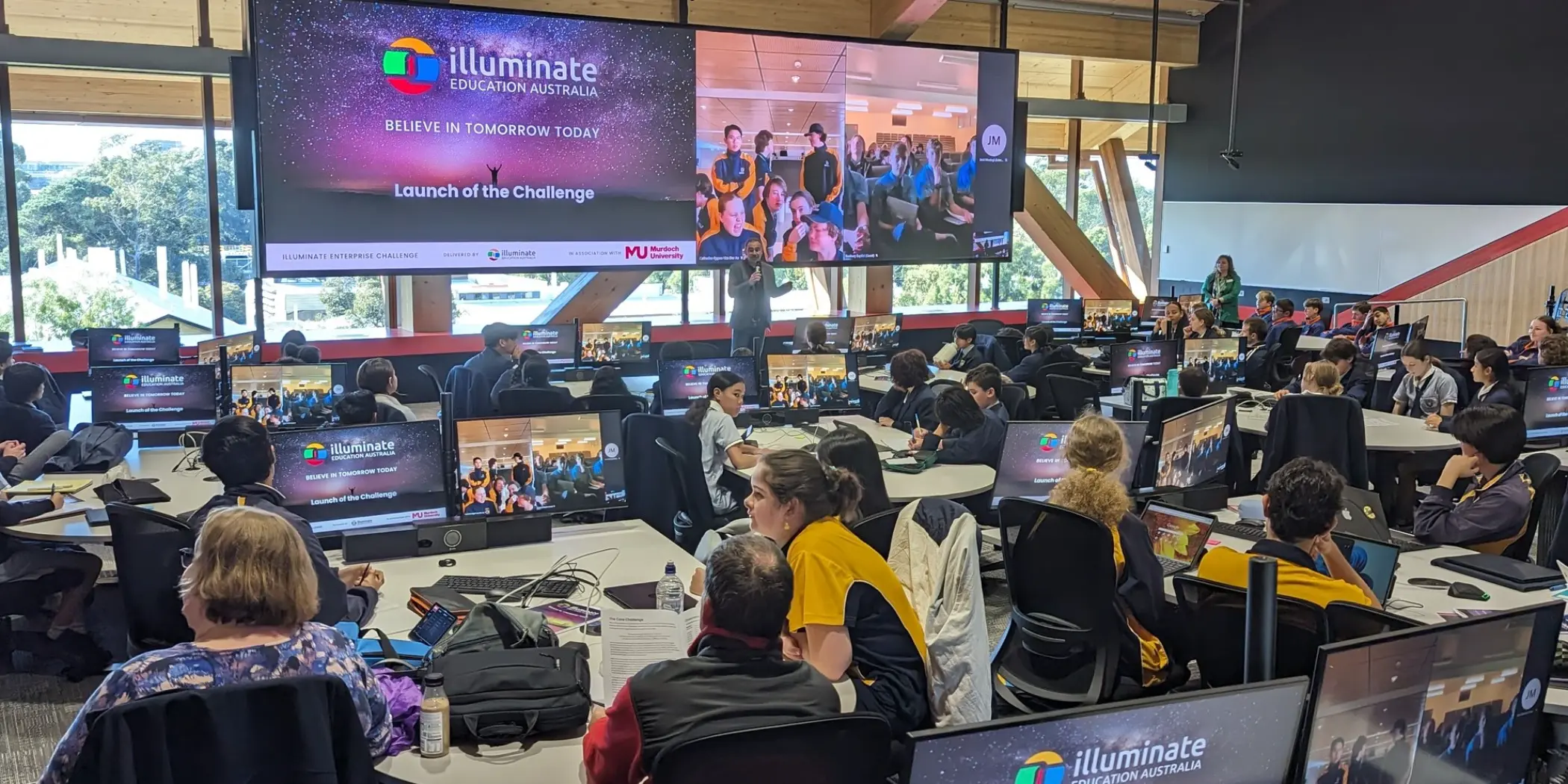
We come to your child’s school
Every program is delivered on site, shaped around the school’s timetable. Your child does not need to go anywhere.
Qualified, registered teachers throughout
Our team are a mix of certified educators who also bring real experience from community leadership, social enterprise and industry.
Working with students since 2011
More than 30,000 students across 350+ schools in every state and territory. The approach is tested and the outcomes are consistent.
Australia-wide delivery
Metropolitan, regional and remote. Primary and secondary. Years 3 to 12. illuminate travels to the community – not the other way around.
Curriculum aligned
Every program maps to the Australian Curriculum. All student work can be returned to the school for internal assessment.
why this matters for your child
These are the capabilities that carry forward into every subject and every stage of life.
The capabilities illuminate builds are not subject-specific. They sit beneath all learning — and they are the capabilities that communities, employers and universities consistently say matter most. Your child will use these long after the program week is over.
illuminate’s skills framework was developed through consultation with industry partners and a review of current literature. It describes the capabilities young people need to be confident, creative and capable – relevant to school, to community, to industry and to life. It has been developed through consultation with industry partners, educational research, and alignment to the Australian Curriculum. We are focused on building skills like…
Speaking
Writing
Presentation skills
Critical thinking
Inquiry and research
Digital literacy
Financial literacy
Creativity
Design thinking
Problem solving
Reflection
Collaboration
Leadership
Organisation
Perseverance
Entrepreneurial thinking
Community engagement
Resilience
These capabilities are woven through every single illuminate Education Australia program.
How you can help
Your support at home makes a real difference to what your child takes from this experience.
The program is designed to be challenging – that is what makes it valuable. There will be moments when your child feels uncertain, frustrated or stretched. That is not a sign something is wrong. It is a sign the learning is happening. Here is how you can help.
Encourage
Encourage them to keep going when it gets hard.
Some of the most valuable growth in the program happens in the moments that feel most difficult. If your child comes home saying it is challenging, that is a good sign – not a reason to pull back. Help them reflect on what they are finding hard and why, and encourage them to stick with it.
be curious
Ask about their idea – and take it seriously.
Your child will be developing a real idea across the program. Ask them what problem they are working on. Ask who is in their team. Ask what they are proposing and why it matters. The fact that an adult at home is genuinely interested in their work signals that it is genuinely worth doing.
share your experience
Share your own experiences of working in teams.
Collaboration, communication and navigating disagreement are things your child will be practising during the program. Sharing your own experiences – times when working with others was difficult, and what helped – gives them something real to connect the learning to.
time management
Help them manage their time and energy across the week.
The program is intensive but one students can manage. A good night’s sleep, a decent breakfast and arriving on time each day make a real difference to what your child can contribute. Supporting them practically is one of the most useful things you can do.
respect the process
Be patient with the process – not just the outcome.
Your child may not be able to explain exactly what they are working on every day, or why a particular stage is taking the direction it is. Trust the process. The learning often becomes clearer after the program than during it.
reinforcement
Reinforce that these skills matter – because they do.
Confidence, creativity, problem solving, working with others – these are not soft extras. They are the capabilities that employers, universities and communities consistently ask for. Helping your child understand why they are developing these skills gives the experience more meaning.
How you can best support the program, and your child.
The illuminate program asks something of students. It also asks something of the families supporting them. As a parent or guardian, your involvement at home shapes how much your child gets from the week.
Commitment to the above is what we ask of every family whose child participates. It is not a formal obligation. It is an invitation to be part of something that genuinely matters to your child’s development.
What to expect from your child
Some things that are completely normal – and what they usually mean.
They come home tired and frustrated.
The program is genuinely intensive. Cognitive and emotional effort across a full day is tiring, and the full day workshop means they are likely more focused than when they regularly change classes at school. This is not a sign something has gone wrong – it is a sign the work is real. A good sleep and a conversation about what happened usually helps.
They can’t fully explain what they’re working on.
Complex, collaborative work is hard to summarise in a sentence. Ask open questions – what problem is your team solving, who is in your team, what happened today – rather than expecting a neat summary.
They feel unsure about their idea or their team.
Uncertainty is part of the creative process – and there is never a “right idea” in this sort of process. Teams that feel completely confident mid-week often produce less interesting final work than teams that struggled with doubt. Encourage them to keep going.
They come home unexpectedly energised.
Many students hit a point in the program – often unexpectedly – where something clicks. They become excited and engaged in a way that is different from normal school. Lean into it. Ask what shifted.
They want to talk about their idea at length.
This is a very good sign. Let them. Ask questions. Take their thinking seriously. The best thing you can do in this moment is be a genuinely interested audience.
They seem different after the program ends.
Teachers frequently tell us that students return to their regular classes with a different approach to learning – more confident, more willing to contribute. This is what the program is built to produce. It is worth noticing and naming when you see it.
Common QUestions
Things parents often ask before the program begins.
Does my child need to prepare anything beforehand?
No. All content is introduced by our team during the program. Your child arrives as they would for a normal school day. We arrive ready – no reading, research or preparation is required from students or families.
What if my child is shy or finds group work hard?
The program is specifically designed to build confidence in students who do not yet feel comfortable contributing in group settings. Our team creates the conditions for every student to participate – the pace and scaffolding are shaped around the cohort in the room, not an assumed level of prior confidence. We also know teachers are aware of who could feel uncomfortable in this environment, and can support alongside our team to help support them to get the most from the experience.
Will my child's work be assessed?
All student work produced during the program can be returned to the school for internal assessment. Speak to your child’s teacher or the school coordinator if you would like to know more about how the school intends to use the work – but we also know that the work is developed by a group who might have different levels of endeavour and commitment to tasks, and schools do take this into account when grading.
Who are the illuminate team members working with my child?
Our team are qualified, registered teachers who also bring real experience in community leadership, social enterprise and industry. All team members have Working With Children checks and relevant clearances. They work alongside your child’s school teachers throughout the program.
What happens if my child misses a day?
Talk to the school if you know your child will be absent. The program is team-based and sequential – missing a day has an impact on the team as well as the individual student, but just like when you miss a commitment at work or in the community, it’s best when it is known and effort is made to accommodate this happening. Our team and the school will work together to support your child on their return where possible.
Can I come and see the final pitch?
Typically the pitch session is done just with our judges, as we know it can be quite nerve-racking to present infront of a large audience, and we want the students to be supported and comfortable to present everything they have done over the program. Saying that, if the program is long enough and has an awards ceremony, this allows you to see parts of their work – and the other teams participating alongside them – to celebrate what they have achieved together.
What the program involves
Your child will work in a team to identify a real problem and develop a real solution to it.
Depending on the program, this takes between one day and a full week. Every program moves through the same six stages – building from how the team works together right through to a final pitch in front of real community members, industry leaders or school staff.
Stage 1
Building the team
Your child’s team establishes how they will work together – their shared commitments, how they will make decisions and how they will support each other when things get challenging.
Stage 2
Finding the right idea
Teams explore a real problem – something that genuinely matters to their school or community – and generate a wide range of possible solutions before selecting the strongest direction.
Stage 3
Developing the idea
Teams turn their idea into a fully considered proposal – working through what it would cost, who it is for and how it would actually work. This is often the hardest stage, and the most rewarding.
Stage 4
Learning to communicate it
Teams develop the ability to explain their thinking clearly and persuasively to people outside the team – a skill they will use throughout school and well beyond it.
Stage 5
Testing and refining
Ideas are tested through real feedback from community members and peers. Students learn to listen, adapt and improve – one of the most valuable things the program builds.
Stage 6
The final pitch
Teams present their complete proposal to a panel of real people – community leaders, industry representatives or school staff – who are genuinely listening to what they have produced.